How to Start a Faceless YouTube Channel in 2026 (Step-by-Step Guide)
Want to start a faceless YouTube channel but don't know where to begin? This step-by-step 2026 guide walks you from picking a data-backed niche to publishing your first video.
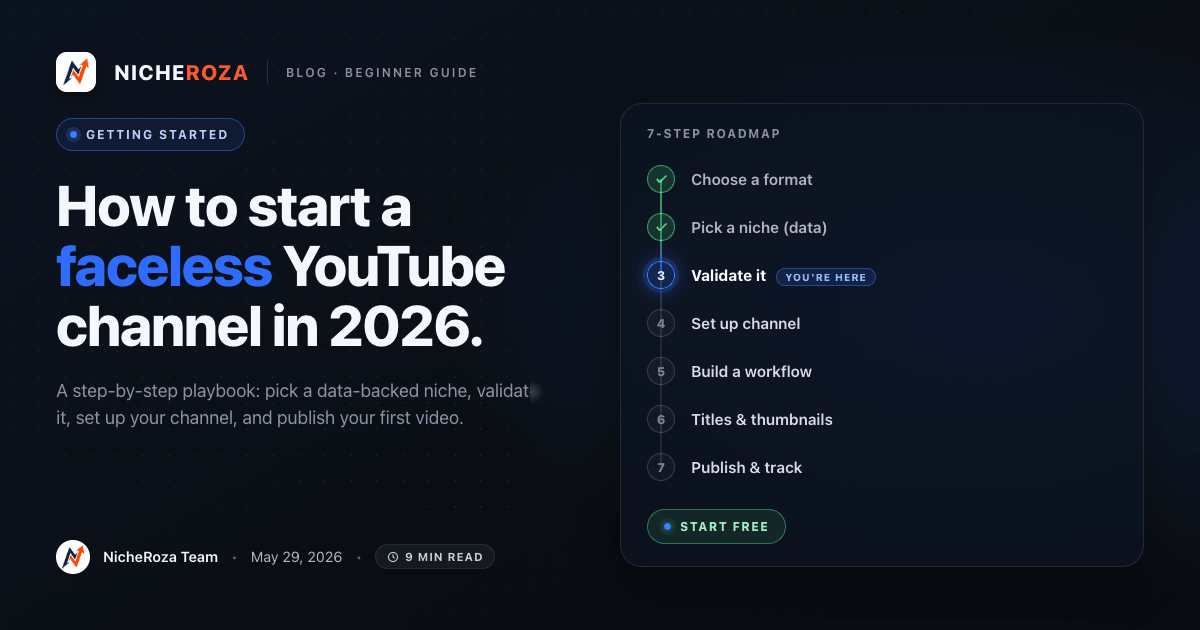
Short answer: To start a faceless YouTube channel in 2026 you don't need to show your face, own a camera, or be on screen — you need a repeatable system. Follow seven steps: choose a faceless format that fits you, pick a niche backed by data rather than a hunch, validate that niche before committing, set up your channel properly, build a repeatable production workflow, nail your titles and thumbnails, then publish consistently and read the data. Most channels fail from a wrong niche or quitting early, not lack of talent.
Starting a faceless YouTube channel in 2026 is more realistic than ever — you don't need to show your face, own a camera, or even be on screen for a second. What you do need is a repeatable system: a proven niche, a clear format, and a publishing routine you can actually keep up. Most channels fail not because the creator lacked talent, but because they picked the wrong niche or quit before the algorithm had enough data to work with.
This guide walks you through the whole process step by step, in the order that actually matters. Follow it and you'll launch with a channel that's built on evidence instead of guesswork.
Step 1: Choose a Faceless Format That Fits You
Before the niche, decide how you'll produce videos, because that determines everything downstream. The most common faceless formats are narration over stock or AI-generated visuals, documentary-style explainers, list videos, screen-recording tutorials, and relaxation or ambient content. Pick one you can produce consistently with the time and skills you have. A format you can ship weekly beats a fancy one you'll abandon in a month.
Step 2: Pick a Niche Backed by Data, Not a Hunch
This is the step that decides whether your channel earns or stalls. A good niche has three things at once: real demand, a healthy RPM, and room for small channels to break through. Don't pick a niche because it "feels" popular — verify it.
Look for small channels posting outlier videos (videos that massively beat their own channel average), because that signals a copyable, winnable pattern rather than a saturated space dominated by giants. If you want a shortlist of niches that already balance demand and earnings, start with our guide to the best faceless YouTube niches in 2026.
Step 3: Validate the Niche Before You Commit
Picking a niche and validating it are two different things. Validation means confirming, with data, that the niche can actually work for you in your target market. Check three signals: are small channels breaking through (use an outlier engine to see this fast), what's the realistic RPM for your country, and is the niche genuinely faceless or do the top channels secretly rely on a presenter?
Doing this manually across thousands of channels takes hours. NicheRoza runs all three checks at once and has a free plan, so you can validate before you produce a single video. If you're comparing tools for this stage, our NexLev alternative breakdown covers what to look for.
Step 4: Set Up Your Channel the Right Way
Create your channel with a clear, searchable name that hints at the niche, a clean banner and logo, and an "About" section that tells viewers exactly what they'll get. Keep branding consistent so your thumbnails are instantly recognizable. You don't need expensive design — clarity beats decoration. Set your channel's country and language to match the audience you're targeting, since that influences who YouTube recommends you to.
Step 5: Build a Repeatable Production Workflow
The creators who last are the ones who systematize. Break each video into stages — research, script, voiceover, visuals, editing, thumbnail, upload — and batch similar tasks together. Write several scripts in one sitting, record voiceovers in another. AI tools can speed up scripting, narration, and visuals, but keep a human eye on quality, because polished, accurate content is what separates channels that grow from channels that blend in.
Step 6: Nail Titles and Thumbnails
Your title and thumbnail decide whether anyone clicks. Study the outlier videos in your niche and notice the patterns in how they phrase titles and frame thumbnails — then apply those patterns in your own voice without copying. A strong thumbnail is simple, high-contrast, and readable at small sizes. Treat the title and thumbnail as the most important part of every video, because they are.
Step 7: Publish Consistently and Read the Data
Upload on a schedule you can sustain, then let the data guide you. Watch which videos outperform your own average and make more like them. Don't panic over early videos with low views — channels need a body of content before the algorithm understands who to show them to. Track your growth, double down on what works, and quietly retire what doesn't.
Conclusion
Starting a faceless YouTube channel in 2026 comes down to a simple sequence: choose a format you can sustain, pick a niche backed by real data, validate it before you commit, set up cleanly, systematize production, and publish consistently while reading the signals. The biggest mistake is rushing past validation and producing dozens of videos in a niche that was never going to pay. Get the niche right first, and everything after it gets easier.
FAQs
Can you really make money on a faceless YouTube channel? Yes. Many faceless channels monetize through AdSense once eligible, and earnings depend heavily on niche and audience country rather than just view count.
How many videos before a faceless channel takes off? There's no fixed number, but most channels need a consistent body of content before the algorithm can recommend them effectively. Consistency matters more than any single video.
Do I need expensive equipment to start? No. A faceless channel can be built with a basic microphone for voiceover and free or low-cost editing tools. The bigger investment is in research and consistency.
What's the most important step when starting? Niche validation. Picking a niche with real demand, a healthy RPM, and room for small channels to break through is what determines whether the channel earns or stalls.
Start faceless niche research. Free.
Outlier detection, AI Score, channel tracking — in one panel. No card required.
Start free →