YouTube RPM by Country: How Much Faceless Channels Really Earn in 2026
Two channels can get identical views and earn completely different amounts. Here's why YouTube RPM swings by country and niche in 2026 — and how to estimate your own faceless channel income.
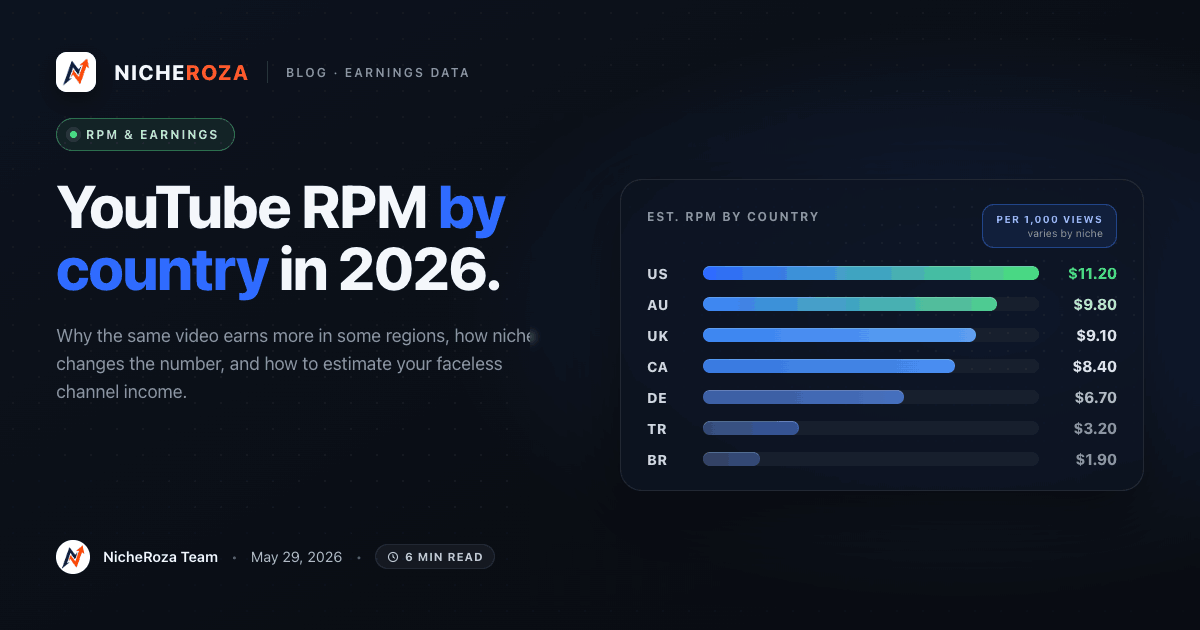
Short answer: Two channels can get identical views and earn very different amounts because YouTube RPM — what you actually take home per 1,000 views after YouTube's cut and unmonetized views — swings dramatically with the viewer's country and the video's niche. Audiences in high-advertiser-value countries and high-paying niches (like finance) generate far higher RPM than the same views from low-RPM regions or low-value topics. That's why "how much per 1,000 views?" never has a single answer.
Two channels can post the exact same video, get the exact same number of views, and earn wildly different amounts. The reason usually isn't the content — it's where the audience is watching from and what niche the video sits in. This is the single most misunderstood part of faceless YouTube income, and it's why "how much will I make per 1,000 views?" never has one answer.
This guide explains what RPM is, why it swings so hard between countries and niches, which regions and topics pay the most in 2026, and how to estimate your own channel's earnings before you commit to a niche.
RPM vs CPM: What You're Actually Measuring
People use these terms interchangeably, but they measure different things, and the difference matters for planning.
CPM is what advertisers pay per thousand ad impressions. RPM is what you actually take home per thousand video views, after YouTube's cut and after accounting for views that showed no ads at all. RPM is always lower than CPM, and it's the number that reflects your real income. When you read that a niche "pays $10," that figure is only useful if you know whether it's CPM or RPM — and for planning your own earnings, RPM is the one to anchor on.
Why RPM Varies So Much by Country
The biggest driver of RPM is advertiser demand in the viewer's country. Advertisers in some markets simply pay far more to reach an audience, so views from those countries are worth more to you.
As a general pattern in 2026, the highest-paying viewer countries tend to be the United States, Australia, the United Kingdom, Canada, and parts of Northern and Western Europe. Mid-tier markets include much of Southern and Eastern Europe and parts of the Gulf. Lower-RPM markets often include large-population regions in South and Southeast Asia, Latin America, and Africa — not because the audiences are less valuable as people, but because local advertising rates are lower.
The practical takeaway is that audience geography is a real lever. A channel with 70% US viewers can out-earn a channel with ten times the views from low-RPM regions. If you can choose a niche and language that naturally attract higher-RPM audiences, you change your economics before you ever upload.
Why Niche Matters as Much as Country
Country sets the range; niche sets where you land inside it. Within the same country, RPM can differ several times over depending on topic, because advertisers in some verticals compete much harder for attention.
Finance, business, technology, and certain education topics consistently sit near the top, because the advertisers there have high budgets and high customer value. Mid-range niches include many lifestyle, productivity, and general-interest topics. Lower-RPM niches often include entertainment, kids content, and some music-driven formats — which can still earn well, but only through very high view volume rather than per-view value.
This is exactly why niche selection isn't only about views. A smaller finance or tech channel can out-earn a much larger entertainment channel. If you want to dig into which faceless niches combine demand with strong RPM, our guide to the best faceless YouTube niches in 2026 breaks them down.
How to Estimate Your Own Channel's Earnings
Generic "average RPM" numbers are nearly useless because they blend every country and niche into one figure. To estimate realistically, you need three inputs: your niche, your audience's main country, and your expected view volume.
Doing this by hand means hunting through other creators' income screenshots and hoping their audience matches yours. A faster approach is to model it directly. NicheRoza's RPM predictor estimates monthly AdSense income across 14 categories and 20 countries, so you can plug in your specific niche and target region instead of relying on a global average. It's part of the free plan, so you can sanity-check a niche's earning potential before you produce anything.
From there, the workflow is simple: confirm the niche has small channels breaking through using the outlier engine, check the RPM for your country, and only then commit. That order — validate, then produce — is what separates channels that earn from channels that just upload. If you're weighing tools for this, our NexLev alternative comparison covers what to look for.
Conclusion
YouTube RPM isn't a single number — it's a range set by your audience's country and narrowed by your niche. In 2026, the creators who earn the most aren't always the ones with the most views; they're the ones who picked a high-RPM niche and naturally attract higher-paying audiences. Before you build a content plan around expected income, estimate it for your actual niche and region, and treat any "average RPM" figure with healthy skepticism.
FAQs
What is a good RPM on YouTube in 2026? It depends entirely on your niche and audience country. Finance and tech channels with audiences in high-paying markets can see much higher RPMs than entertainment channels, even at lower view counts.
Which countries have the highest YouTube RPM? Markets like the United States, Australia, the United Kingdom, and Canada generally rank among the highest, driven by strong advertiser demand. Exact figures shift over time and by niche.
Why is my RPM lower than other creators in my niche? The most common reasons are audience geography (more views from lower-RPM countries) and ad-friendliness of your content. Two channels in the same niche can differ significantly based on where their viewers are.
How can I estimate my earnings before starting a channel? Use a tool that factors in both niche and country rather than a single global average. NicheRoza's RPM predictor estimates monthly income across 14 categories and 20 countries on its free plan.
Start faceless niche research. Free.
Outlier detection, AI Score, channel tracking — in one panel. No card required.
Start free →