Why Your Faceless YouTube Channel Isn't Getting Views (2026 Fix Guide)
If your faceless YouTube channel isn't getting views, it's almost never bad luck — it's a fixable cause. This 2026 guide breaks down the real reasons videos stall and exactly how to fix each one.
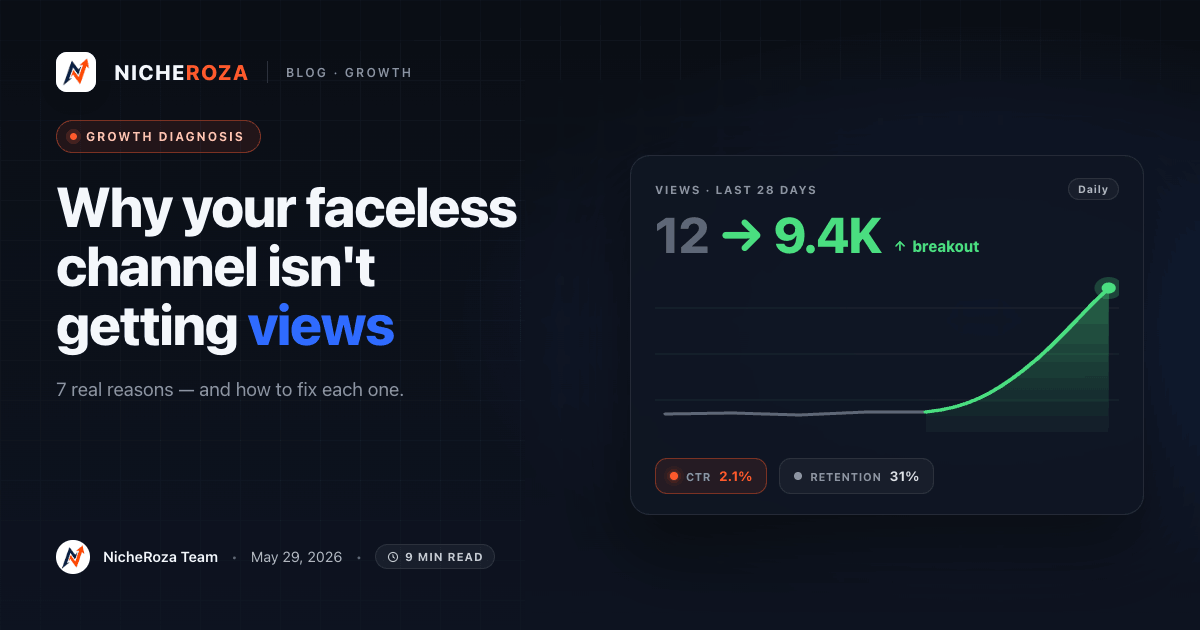
Short answer: A faceless channel usually isn't getting views because of a fixable signal problem, not bad luck or a shadowban. YouTube shows each video to a small test audience and only expands reach if click-through rate (do people click the thumbnail?) and retention (do they keep watching?) are strong. Trace low views back to one of three things: a poor niche choice, weak titles/thumbnails, or a weak hook — then fix that specific bottleneck.
You've uploaded video after video, the production looks clean, the narration is solid — and still, the views barely move. It's the most demoralizing stage of running a faceless YouTube channel, and it's also the most misunderstood. The good news: low views are almost never bad luck or a "shadowban." They're a signal, and nearly every cause is fixable once you know what to look for.
This guide breaks down the real reasons a faceless channel isn't getting views in 2026, in the order they actually matter — from the niche you chose, to whether anyone clicks, to whether they stay. For each cause you'll get a clear fix, so you can diagnose your own channel instead of guessing. Let's find the bottleneck.
First, How YouTube Actually Decides to Show Your Video
Before the causes, you need the mental model. YouTube doesn't "promote" videos because they're good — it shows a video to a small test audience, watches how they respond, and expands reach only if the signals are strong. The two signals that matter most are click-through rate (did people click when shown the thumbnail?) and retention (did they keep watching once they clicked?). Views are the result of those two things working together. If either is weak, the video stalls no matter how much effort went into it. Almost every "no views" problem traces back to one of these two signals — or to a niche choice that doomed them before you uploaded.
Reason 1: You Picked the Wrong Niche
This is the most common and most painful cause, because no amount of editing fixes it. If you chose a niche with little demand, or one totally saturated by giant channels, your videos were fighting uphill from the first upload.
How to Tell If Your Niche Is the Problem
Look at small channels in your niche. If only massive, established channels get views and no small channel is breaking through, the barrier to entry is too high. If, on the other hand, small channels are posting videos that massively beat their own averages, the niche is healthy and the problem is elsewhere.
The Fix: Validate With Outlier Data
The signal you want is the outlier — a small channel with a single video that hugely outperformed its norm. That gap proves a repeatable, copyable opportunity exists. Checking this manually is slow, which is exactly why NicheRoza's outlier engine scores videos against their own channel average so you can see at a glance whether a niche is winnable. If you're reconsidering your niche entirely, start with our guide to the best faceless YouTube niches in 2026.
Reason 2: Nobody Is Clicking (Weak Click-Through Rate)
If YouTube is showing your video (you have impressions) but few people click, the problem is your packaging — the title and thumbnail. This is the single most common fixable cause of low views.
Your Thumbnail Isn't Doing Its Job
A thumbnail has to communicate one clear idea and be readable at a tiny size. Cluttered, low-contrast, or text-heavy thumbnails get scrolled past. Study the thumbnails on the outlier videos in your niche, notice what they have in common, and apply those patterns in your own style.
Your Titles Aren't Compelling
Titles should promise a specific, curiosity-driven payoff without lying about it. Vague or generic titles give viewers no reason to click. Again, the outliers in your niche are your template — reverse-engineer the phrasing that's already working.
The Fix: Reverse-Engineer What Already Works
Don't guess at titles and thumbnails. Find the videos in your niche that overperformed and study their packaging directly. This is faster and more reliable than testing blind, and it's a core part of the validation workflow.
Reason 3: People Click but Don't Stay (Poor Retention)
If people click but leave quickly, YouTube reads that as "this video didn't deliver" and stops showing it. Retention, especially in the first 30 seconds, is decisive.
Weak Hooks in the First 15 Seconds
The opening of a faceless video is where most viewers decide to stay or go. A slow intro, a long logo animation, or a rambling setup kills retention instantly. Open with the payoff or a clear promise of what's coming.
Pacing and Visual Problems
Faceless videos rely entirely on narration and visuals to hold attention. Long static shots, mismatched B-roll, dead air, or a monotone voice all push viewers away. Tighten the edit, cut silences, and keep the visuals moving in sync with the narration.
The Fix: Script and Edit for Retention
Write a strong hook first, keep the script tight, and edit ruthlessly. A shorter video that holds attention beats a longer one that loses it. For a full production system that bakes retention in, see our guide to faceless YouTube automation.
Reason 4: Your Titles and Topics Don't Match Search or Browse Demand
Sometimes the video is good but nobody is looking for it, or the way it's framed doesn't match how people actually search. If your topic has no real demand, even a perfect video has a tiny ceiling.
The Fix: Make Data-Backed Topics
Choose topics with proven demand instead of whatever you feel like making. Look at what's already overperforming in your niche and make your own version with a fresh angle. Demand first, creativity second — that order is what separates videos that get discovered from ones that disappear.
Reason 5: You're Not Consistent Enough
The algorithm needs data to understand who to show your channel to, and it gets that data from a steady stream of uploads. Posting three videos in a week, then nothing for a month, starves it of signal. Inconsistency is one of the quietest channel killers.
The Fix: A Sustainable Schedule
Pick a cadence you can actually maintain — even once a week is fine — and hold it. Batch-producing videos in stages makes consistency far easier. A predictable schedule you can keep beats an ambitious one you'll abandon.
Reason 6: Your Channel Is Brand New (and That's Normal)
If your channel is only a few videos old, low views may simply mean YouTube doesn't have enough data yet. This stage is normal and temporary. The mistake is panicking and changing everything before the algorithm has had a chance to learn.
The Fix: Patience Plus a Body of Content
Keep publishing consistently and give the channel a body of work to be judged on. Most channels need a meaningful number of videos before any one of them breaks out. Don't delete early videos or pivot wildly — stay the course while watching your data. Our step-by-step guide to starting a faceless YouTube channel lays out the right early sequence.
Reason 7: You're Copying Instead of Differentiating
Studying outliers is smart; cloning them is not. If your videos look like slightly worse versions of bigger channels, viewers have no reason to choose yours. The algorithm also struggles to position content that's indistinguishable from what already exists.
The Fix: Same Pattern, Your Angle
Use the proven patterns — topic types, title structures, thumbnail styles — but add a clear angle that's yours: a sharper script, a unique visual treatment, a more specific sub-niche. Familiar enough to click, different enough to choose.
A Quick Diagnostic Checklist
To find your specific bottleneck fast, work through these in order:
- Check your impressions. If they're near zero, the issue is niche demand or the channel being too new.
- Impressions healthy but click-through low? Fix your titles and thumbnails.
- Click-through fine but viewers leave early? Fix your hook and pacing.
- Individual videos look okay but the channel isn't growing? Check your consistency and whether your content is differentiated.
Diagnosing in this order saves you from "fixing" the wrong thing.
How NicheRoza Helps You Get Unstuck
Most of these problems share one root cause: producing without validating first. NicheRoza is built to remove that guesswork. The outlier engine shows you whether small channels are actually winning in your niche, the RPM predictor confirms whether the niche is worth your time financially across 14 categories and 20 countries, and the thumbnail face-detection filter keeps you focused on genuinely faceless opportunities. You can start free, validate your niche and study the videos already overperforming, then make data-backed videos instead of hoping. If you want to understand the earnings side too, see our guides on YouTube RPM by country and how much faceless channels make.
Conclusion
If your faceless YouTube channel isn't getting views, it's not bad luck — it's a diagnosable, fixable signal. Work through the causes in order: confirm the niche is winnable, fix click-through with stronger titles and thumbnails, fix retention with better hooks and pacing, make data-backed topics, stay consistent, be patient if you're new, and differentiate instead of copying. Almost every stalled channel is failing on one or two of these, not all of them. Find your bottleneck, fix that one thing, and the views usually follow.
FAQs
Why is my faceless YouTube channel getting no views? Almost always one of a few causes: a niche with low demand or too much competition, weak titles and thumbnails (low click-through), poor retention, inconsistency, or simply being too new. Diagnose by checking impressions, click-through, and retention in that order.
Is my channel shadowbanned? Almost certainly not. "Shadowban" is rarely the real issue. Low views are far more often caused by click-through, retention, or niche problems that are fully within your control to fix.
How long until a faceless channel starts getting views? It varies, but most channels need a consistent body of content before any video breaks out. Patience plus consistency matters more than any single upload, especially in the first few months.
How do I know if my niche is too competitive? Look for small channels posting videos that beat their own averages. If small channels are breaking through, the niche is winnable; if only giants get views, the barrier is too high. A tool like NicheRoza's outlier engine shows this quickly.
What's the fastest thing to fix for more views? Usually titles and thumbnails. If you have impressions but few clicks, improving your packaging is the quickest lever — study the outliers in your niche and apply what's already working.
Start faceless niche research. Free.
Outlier detection, AI Score, channel tracking — in one panel. No card required.
Start free →