Faceless YouTube Automation: The Complete 2026 Guide
Faceless YouTube automation lets you run a channel without showing your face or being on camera. This complete 2026 guide breaks down the entire workflow, the tools for each stage, realistic costs, and how to scale.
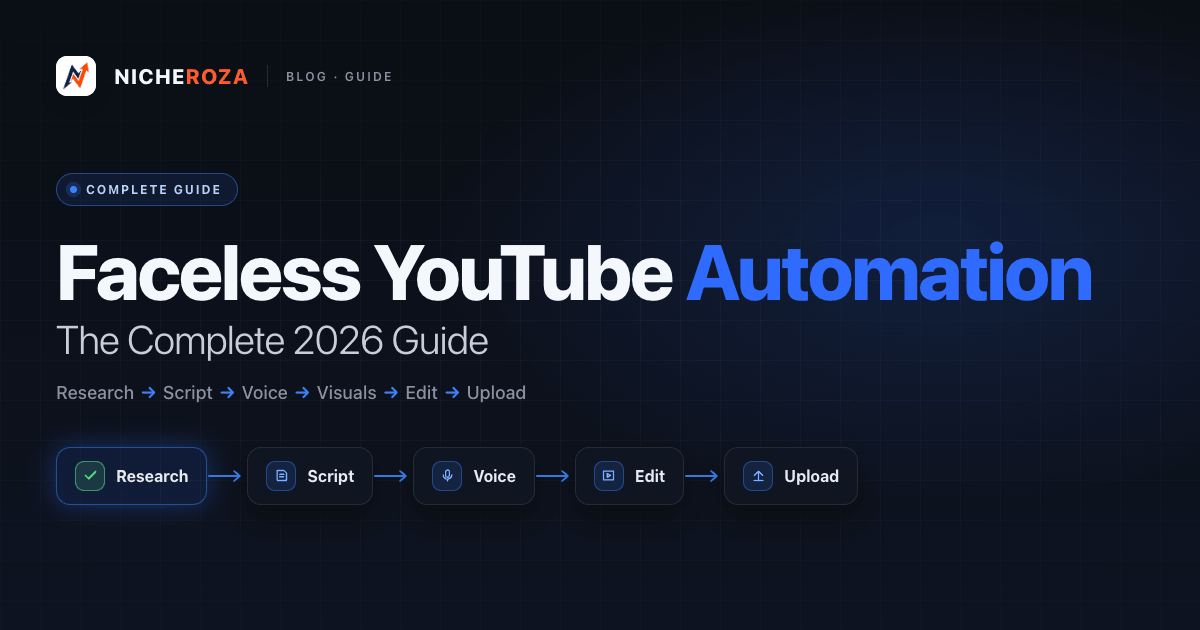
Short answer: Faceless YouTube automation means running a channel that grows and earns without you appearing on camera or recording in a studio. It works as a repeatable seven-stage system — niche research, scripting, voiceover, visuals, editing, thumbnail and title, then upload and review — where each stage is handled by a tool or process rather than one person doing everything by hand. Validate the niche first, then build a lean, repeatable production pipeline you can scale.
Faceless YouTube automation is the practice of running a YouTube channel that grows and earns without you ever appearing on camera, recording your own voice in a studio, or being the on-screen personality. In 2026 it has gone from a niche trick to a full production model: thousands of channels now operate as small content systems, where research, scripting, narration, visuals, and editing are each handled by a repeatable process or tool rather than a single creator doing everything by hand.
This guide is the complete walkthrough. We'll define what faceless automation actually means in 2026, break down the full workflow stage by stage, cover the tools that handle each part, look at realistic costs and earnings, walk through the mistakes that quietly kill channels, and finish with how to scale from one channel to several. If you only read one resource on faceless automation this year, this is built to be it.
What "Faceless YouTube Automation" Actually Means
The term gets thrown around loosely, so it's worth being precise. Faceless automation doesn't mean a channel that runs itself with zero human input — that almost never works and usually produces low-quality content the algorithm ignores. What it really means is a channel built on a repeatable system, where each stage of production is either streamlined, delegated, or assisted by tools so that you can publish consistently without being the bottleneck.
Faceless vs Automated vs Fully Hands-Off
There are three different ideas people blur together. "Faceless" simply means you don't appear on screen — narration, footage, and graphics carry the video. "Automated" means parts of the workflow are handled by tools or templates so production is fast and consistent. "Fully hands-off" means you outsource or automate nearly everything and act more like a manager than a creator. Most successful channels in 2026 are faceless and partly automated, but still have a human steering quality. The fully hands-off dream exists, but only after you've built a system that works.
Why It Works So Well in 2026
Three shifts made this model mainstream. AI narration became good enough to be indistinguishable from human voiceover for most niches. AI-assisted scripting and editing collapsed the slowest parts of production. And research tools made it possible to validate a niche with data before investing weeks of work. Together, these mean a single person can now produce content that used to require a small team.
The Complete Faceless Automation Workflow
The heart of this guide is the workflow. A faceless channel is really a pipeline, and understanding the order of stages is what separates a system from a mess. Each stage feeds the next, and the biggest mistakes happen when creators skip straight to production without doing the earlier steps.
Stage 1: Niche Research and Validation
This is the stage that decides whether everything downstream is worth doing. A great video in a dead niche earns nothing. Before anything else, confirm three things: that there's real demand, that small channels (not just giants) are breaking through, and that the niche genuinely pays through a healthy RPM.
The strongest signal is an outlier — a small channel with a single video that massively outperformed its own average. That gap is a copyable, repeatable pattern. Validating this manually across thousands of channels takes hours, which is exactly why research tools exist. NicheRoza is built for this stage: its outlier engine scores videos against their own channel average, and the RPM predictor estimates earnings across 14 categories and 20 countries on a free plan. If you're choosing a niche from scratch, our guide to the best faceless YouTube niches in 2026 is the place to start.
Stage 2: Scripting
Once the niche is validated, every video starts as a script. Large language models are excellent drafting partners here — use them to generate an outline, expand each section, then edit heavily for accuracy and voice. In fact-driven niches like history, finance, or science, verify every claim, because confident-sounding errors are the fastest way to lose a knowledgeable audience. The script is also where retention is won or lost: a strong hook in the first 15 seconds matters more than anything else in the video.
Stage 3: Voiceover and Narration
Narration is the single biggest unlock of the faceless model. Modern AI text-to-speech voices are natural enough that most viewers can't tell, which removes the need for your own voice or a paid voice actor. Pick a voice that matches your niche's tone — calm and measured for sleep or stoic content, energetic for list videos — and keep it identical across every upload so your channel has a recognizable identity.
Stage 4: Visuals and B-Roll
Visuals depend on format. Documentary and history channels blend AI-generated imagery with archival footage; explainer channels lean on clean motion graphics; relaxation channels use long, slow ambient footage. Whatever the niche, prioritize visual consistency and pacing over flashy effects. Retention comes from clarity, not spectacle, and mismatched or jarring visuals are a common reason viewers click away.
Stage 5: Editing and Assembly
AI-assisted editors now handle the tedious parts: auto-captioning, removing silences, suggesting cuts, and assembling rough timelines. This is where automation saves the most time. But always do a final human pass — pacing, music levels, and the rhythm of cuts are judgment calls that separate professional-feeling videos from generic ones.
Stage 6: Thumbnail and Title
Your thumbnail and title decide whether anyone clicks, so they deserve as much attention as the video itself. Study the outlier videos in your niche, notice the patterns in how they phrase titles and frame thumbnails, then apply those patterns in your own style without copying. A strong thumbnail is simple, high-contrast, and readable at small sizes.
Stage 7: Upload, Metadata, and Review
Finally, publish with a clear title, a keyword-aware description, and relevant tags, then let the data guide you. Watch which videos beat your own average and make more like them. Don't panic over early low-view videos — channels need a body of content before the algorithm understands who to recommend them to. For the full beginner sequence, see our step-by-step guide to starting a faceless YouTube channel.
Best Tools for Each Stage
The temptation is to subscribe to everything. Resist it. A lean stack is one tool per stage, added only when a real bottleneck appears. Here's how to think about each category.
Research Tools
This is the stage most "automation tool" lists ignore, and it's the most important. A research tool should answer demand, earnings, and feasibility in minutes. NicheRoza covers all three with outlier detection, a country-level RPM predictor, and a thumbnail face-detection filter that removes vlog and reaction channels so you only see truly faceless niches. If you're comparing options, our NexLev alternative breakdown covers what to look for.
Scripting Tools
Any capable large language model works as a scripting assistant. The skill isn't the tool — it's the editing. Treat AI output as a first draft, not a final script.
Voiceover Tools
AI text-to-speech is the category that makes faceless channels possible. Choose one voice provider, pick a consistent voice, and stick with it.
Visual and Editing Tools
For visuals, choose based on format: generators for imagery-heavy niches, stock libraries for documentary work, motion-graphics tools for explainers. For editing, an AI-assisted editor handles captions and rough cuts. One of each is plenty.
A Full Lean Stack Example
A practical 2026 stack looks like this: one research tool, one scripting assistant, one voice tool, one visual source, and one editor. That's it. Five tools cover the entire pipeline. Add more only when a specific stage becomes a genuine bottleneck — never because something is trending. For more detail on the AI side specifically, see our roundup of the best AI tools for faceless YouTube channels.
How Much Does Faceless Automation Cost?
Starting costs are lower than most people expect. The research stage can begin free, scripting tools range from free to modest monthly fees, voiceover and editing tools are typically subscription-based, and visuals vary from free stock to paid generators. A lean beginner stack can run on a small monthly budget, with the biggest early "cost" being your time learning the workflow.
As you scale, costs shift from tools to delegation — paying scriptwriters, editors, or voice talent to remove yourself as the bottleneck. The key principle: spend on the stage that's slowing you down most, not on collecting subscriptions you won't use.
How Much Can a Faceless Automation Channel Earn?
Earnings come down to views multiplied by RPM, then extended by income beyond ads. RPM depends heavily on niche and audience country — finance and tech in high-paying markets can earn many times more than entertainment in low-RPM regions. Beyond AdSense, affiliates, sponsorships, and digital products often make up the majority of a mature channel's income.
Because the variables swing so much, generic "per 1,000 views" figures are nearly useless. Estimate for your specific niche and country instead. We break the full picture down in our guides on YouTube RPM by country and how much faceless channels actually make.
Common Faceless Automation Mistakes to Avoid
Most failed channels make the same handful of errors. The first is skipping research and producing content in a niche that was never going to pay. The second is chasing full automation too early, which produces low-quality videos the algorithm buries. The third is inconsistency — publishing in bursts, then disappearing, before the algorithm has enough data. The fourth is neglecting titles and thumbnails while obsessing over the video itself. And the fifth is collecting tools instead of building a workflow. Avoiding these five is most of the battle.
How to Scale a Faceless Automation Channel
Scaling has two paths. The first is depth: systematize your single channel by batching tasks — write several scripts in one sitting, record multiple voiceovers, edit in blocks — and gradually delegate the stages you're worst at or that take the most time. The second is breadth: once one channel runs on a proven system, you can launch a second in a different validated niche, reusing the same workflow. The mistake is trying to scale breadth before the first system actually works. Prove the pipeline once, then replicate it.
Conclusion
Faceless YouTube automation in 2026 isn't a magic button — it's a well-sequenced system. The creators who win research and validate before they produce, run a clean pipeline from script to upload, use a lean set of tools instead of a bloated stack, and stay consistent long enough for the algorithm to reward them. Get the niche right first with real data, build the workflow second, and automate the parts that slow you down third. Do that, and a single person really can run a channel that used to need a whole team.
FAQs
What is faceless YouTube automation? It's running a YouTube channel without appearing on camera, using a repeatable system where research, scripting, narration, visuals, and editing are each streamlined or tool-assisted so you can publish consistently.
Can a faceless channel be fully automated? Partly. You can automate or assist most stages, but the best results still need a human steering quality — especially on niche selection, script accuracy, and final editing. Fully hands-off usually means lower quality.
Is faceless YouTube automation still profitable in 2026? Yes. Faceless formats remain among the fastest-growing on the platform, and earnings depend mostly on choosing a high-RPM niche and publishing consistently rather than on showing your face.
What's the first step to start? Niche research and validation. Before producing anything, confirm there's demand, that small channels are breaking through, and that the niche has a healthy RPM for your target country.
How many tools do I really need? Around five: one for research, one for scripting, one for voiceover, one for visuals, and one for editing. Add more only when a specific stage becomes a real bottleneck.
Start faceless niche research. Free.
Outlier detection, AI Score, channel tracking — in one panel. No card required.
Start free →