YouTube Affiliate Marketing for Faceless Channels: The Complete 2026 Guide
Affiliate marketing is one of the best ways to monetize a faceless YouTube channel — often better than AdSense. This complete 2026 guide covers how it works, what to promote, links that convert, and recurring commissions.
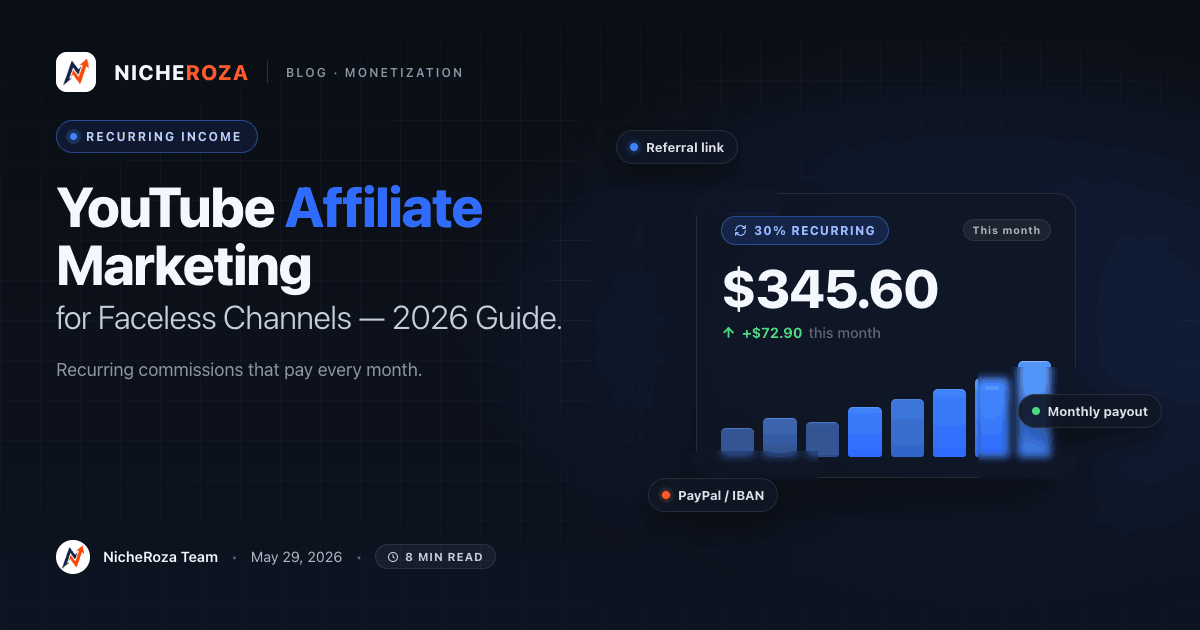
Short answer: Affiliate marketing is often the most profitable way to monetize a faceless YouTube channel — frequently earning more than AdSense — because a single video can keep paying commissions for years and the model works through narration, on-screen text, and a description link rather than an on-camera personality. You pick relevant products, add tracked affiliate links in your descriptions, and earn a commission when viewers buy through them.
For most faceless YouTube channels, AdSense is just the floor. The creators who actually build meaningful income usually earn more from affiliate marketing than from ads — sometimes several times more. The reason is simple: a single video can keep paying commissions for years, you control exactly what you promote, and the whole model fits faceless content perfectly because it works through narration, on-screen text, and a link in the description rather than a personality on camera.
This is the complete 2026 guide to YouTube affiliate marketing for faceless channels. It's long on purpose. We'll cover what affiliate marketing really is, why YouTube is built for it, how to choose a niche and set up your channel, the specific programs worth joining, the exact video formats that convert, how to write descriptions and use pinned comments and end screens, the compliance rules you must follow, how to track performance, the mistakes that cap people's earnings, and how to scale. By the end you'll have a full system, not just tips.
What Is YouTube Affiliate Marketing?
Affiliate marketing is when you recommend a product or service using a unique tracking link, and you earn a commission whenever someone buys or subscribes through that link. On YouTube, the link usually lives in the video description, often reinforced by a verbal mention, an on-screen prompt, or a pinned comment. You don't hold inventory, handle payments, or provide support — you connect an interested viewer to a product and get paid for the introduction.
How YouTube Affiliate Marketing Works
The mechanism is straightforward. You join an affiliate program, receive a unique link or code, and place it where viewers can find it. When someone clicks and completes an action — a purchase, a signup, a subscription — the program attributes it to you through a tracking cookie or referral code and credits your commission. Payouts happen on the program's schedule, usually monthly, once you cross a minimum threshold.
Affiliate Marketing vs Brand Sponsorships
People confuse these two, but they're different. A sponsorship is a flat fee a brand pays you upfront to feature them, regardless of results. Affiliate marketing is performance-based: you earn only when viewers act, but there's no ceiling and no need to negotiate a deal. Sponsorships need an established audience; affiliate links work from your very first video. Many faceless channels start with affiliates and add sponsorships later once they have reach.
Affiliate Income vs AdSense
The key difference is value-per-view. AdSense pays a share of ad revenue based on your RPM, which depends heavily on niche and audience country. Affiliate income can be far higher per viewer because you earn a real commission, not a slice of an ad impression. A video with modest views but strong buying intent can out-earn a viral video monetized only by ads. For the full picture on ad earnings, see our guide on YouTube RPM by country and our breakdown of how much faceless channels make.
Why YouTube Is Perfect for Affiliate Marketing
YouTube has structural advantages that make it one of the best affiliate platforms, especially for faceless creators.
Low Barrier to Entry
Unlike AdSense, which requires meeting the YouTube Partner Program thresholds, you can add affiliate links from your very first upload. There's no subscriber minimum and no waiting period — if you have a video and a relevant product, you can start earning.
Evergreen, Compounding Income
A tutorial or review you publish today can keep getting views — and generating commissions — for years. This compounding effect is why a library of evergreen faceless videos becomes a genuine income engine over time, with older videos quietly earning while you produce new ones.
Multiple Revenue Streams at Once
Affiliate links don't replace AdSense — they stack on top of it. A single faceless video can earn ad revenue, affiliate commissions, and feed into sponsorships and digital products simultaneously. This layering is how mature channels turn modest view counts into meaningful income.
How to Get Started: Niche and Channel Setup
Getting started is mostly about doing things in the right order. Rushing to drop links before you've built relevant content is the most common early mistake.
Choosing a Niche With Buying Intent
Not all niches monetize equally through affiliates. The best ones have viewers actively looking to buy or subscribe to something — software, tools, gear, courses, or services. Tech, finance, productivity, and "how-to" niches convert far better than pure entertainment. If you're still choosing, our guide to the best faceless YouTube niches in 2026 highlights which ones combine demand with monetization potential.
Setting Up Your Channel for Affiliate Success
Before promoting anything, make your channel trustworthy. Use a clear name and banner, an About section that states exactly what you cover, and consistent branding so your thumbnails are recognizable. Trust is what makes viewers click your links, and a polished, focused channel earns that trust faster than a scattered one.
Best YouTube Affiliate Programs to Join
The programs you choose set your ceiling. Here are the main categories and examples, from broad marketplaces to high-value recurring software.
Amazon Associates
Amazon Associates is the most common starting point because almost anything can be linked and viewers already trust the platform. The downside is low commission rates and a short cookie window, so it works best as a supplement for review and "best gear" style channels rather than a primary income source.
ClickBank and Digital Marketplaces
ClickBank and similar marketplaces specialize in digital products and courses, which carry much higher commission rates because there's no physical cost. They fit education-style faceless niches well, though you should vet product quality carefully to protect your credibility.
Affiliate Networks (ShareASale, CJ, Impact)
Larger networks aggregate thousands of brands under one dashboard, making it easy to find programs that match your niche and manage links in one place. They're useful once you know what categories convert for your audience.
SaaS and Recurring Software Programs
For most faceless and creator-focused channels, software programs are the highest-value category, because many pay recurring commissions — you keep earning every month the customer stays subscribed. This is the closest thing to true passive income, and it's exactly the category we'll focus on next.
Recurring vs One-Time Commissions
This distinction matters more than almost anything else in affiliate marketing. A one-time commission pays you once per sale. A recurring commission pays you every month for as long as the customer stays subscribed — turning a single referral into a stream of payments. For faceless creators building evergreen content, recurring programs are the most powerful option, because one well-placed video can generate monthly payouts for years rather than a single payment that resets to zero.
Promote a Tool Your Audience Already Needs: The NicheRoza Affiliate Program
If your channel is in the faceless, creator, or YouTube-growth space, the most natural product to promote is the exact kind of tool your viewers are searching for: a niche research platform. NicheRoza's own affiliate program is built around recurring income, which is why it's the ideal example of this category.
The program pays 30% recurring commission — not a one-time bounty. For every member you refer who goes Pro, you earn a share every single month they stay subscribed, for as long as they stay. It's free to join: you apply, get approved (usually within a day), receive a unique referral link, and share it on YouTube, X, Discord, or your blog. Payouts are made monthly via PayPal or bank transfer, and you track everything in an affiliate panel.
For faceless creators this is an ideal fit, because your audience already wants exactly what the tool does — finding profitable, low-competition niches with outlier detection and country-level RPM data. You can recommend it inside a niche-research tutorial, a "how I find video ideas" video, or a channel-growth guide, and it feels native rather than forced. You can read the full terms and apply on the NicheRoza affiliate page. If you're new to faceless channels yourself, our step-by-step guide to starting a faceless YouTube channel is a good companion piece to send your audience.
Affiliate Video Formats That Convert
The format of your video decides how naturally a recommendation fits. Some formats are built for affiliate marketing; others have to force it. These four convert best for faceless channels.
Product Review Videos
Reviews are the most direct affiliate format. A faceless review walks through a product's features, pros, and cons with narration and screen recordings or B-roll, then links it in the description. Honesty is what makes reviews convert — covering real drawbacks builds the trust that drives clicks.
Tutorial and How-To Videos
Tutorials are the strongest format for software and tools, because you're showing the product in action while solving a real problem. When a viewer sees exactly how a tool helps, the affiliate link becomes the obvious next step rather than a sales pitch.
Comparison and "Best Of" Videos
"Best tools for X" and "A vs B" videos capture viewers at the moment of decision, which is the highest-intent moment there is. These videos can link multiple products and tend to stay relevant for years, making them ideal evergreen affiliate assets.
Listicle and Roundup Videos
"Top 7 tools for faceless creators" style videos are easy to batch-produce and naturally hold several affiliate links. They work especially well because viewers searching for a list are usually ready to try something.
How to Add and Optimize Your Affiliate Links
Having a link isn't enough; placement and framing decide whether anyone clicks.
Writing Effective Video Descriptions
Put your most important link in the first two or three lines of the description, before the "show more" cutoff. Label it clearly, add a one-line reason to click, and keep the list short — two or three focused links convert better than a wall of them.
Using Pinned Comments and End Screens
Reinforce the description link with a pinned comment that restates the offer, since many viewers read comments before the description. Use end screens and on-screen prompts to point viewers toward the link at the moment they're most convinced — right after you've demonstrated the value.
Verbal Mentions and Timing
Mention the link at the natural moment in the narration — after you've shown why the product matters, not at the very start. A well-timed verbal cue paired with an on-screen note dramatically lifts click-through compared to a silent description link.
Affiliate Disclosure and Compliance
This part isn't optional, and getting it wrong risks both trust and your channel.
FTC Disclosure Guidelines
In most regions you're legally required to disclose that your links are affiliate links. A short, clear statement in the description and a brief verbal or on-screen note satisfies this. The disclosure should be easy to notice, not buried at the bottom.
YouTube's Policies on Affiliate Links
YouTube also expects you to mark paid promotions and follow its policies on affiliate and promotional content. Use the platform's paid-promotion tools where applicable, and avoid misleading claims or spammy link stuffing, which can trigger penalties.
Building Long-Term Trust
Beyond rules, disclosure helps you. Audiences trust creators who are upfront, and that trust is what makes them click. Never promote something you wouldn't recommend honestly — one bad recommendation can cost you the credibility that makes all the others work.
Tracking and Analyzing Your Affiliate Performance
What you don't measure, you can't improve. Most affiliate programs give you a dashboard showing clicks, conversions, and earnings. Watch which videos and which products drive the most conversions, not just the most clicks, because a high-click video with low conversions usually signals a mismatch between the audience and the offer. Use link-tracking or UTM tags where possible to attribute sales to specific videos, then double down on the formats and topics that actually convert.
Common Affiliate Marketing Mistakes to Avoid
Most creators leave money on the table the same few ways. The first is promoting too many products at once, which dilutes trust and splits clicks. The second is recommending products irrelevant to the niche, which converts poorly and feels spammy. The third is ignoring recurring programs in favor of one-time payouts that never compound. The fourth is hiding or burying links so no one finds them. The fifth is skipping disclosure, which risks both viewer trust and policy trouble. And the sixth is never checking analytics, so you keep guessing instead of repeating what works. Fix these and your affiliate income usually climbs without any extra views.
How to Scale Your Affiliate Income
Scaling is mostly about doubling down on what already works. Identify which videos drive the most conversions, then make more content around those topics and products. Build evergreen "best tools" and tutorial videos that stay relevant for years. Favor recurring programs so your income compounds over time instead of resetting with every sale. Batch-produce your highest-converting formats to publish consistently. And as your channel grows, negotiate better rates or custom deals directly with the companies you promote most.
Conclusion
Affiliate marketing is the most natural and often the most profitable way to monetize a faceless YouTube channel in 2026. It works before AdSense, compounds over time, and fits the faceless model perfectly because the content does the selling. The winning approach is simple: pick a buying-intent niche, set up a trustworthy channel, promote a small set of products you believe in, favor recurring commissions, build the formats that convert, place and disclose your links honestly, and track what works. Do that consistently, and a single faceless channel can turn into a durable, mostly passive income stream — long after the video is uploaded.
FAQs
Can faceless YouTube channels do affiliate marketing? Yes — faceless channels are ideal for it. Affiliate marketing works through narration, on-screen text, and description links rather than an on-camera personality, so it fits the format naturally.
Do I need a lot of subscribers to start? No. Unlike AdSense, you can add affiliate links from your very first video. Conversions depend more on buying intent and content relevance than on subscriber count.
What's better, recurring or one-time commissions? For faceless creators building evergreen content, recurring commissions are usually far better because a single referral keeps paying every month the customer stays subscribed, turning one video into ongoing income.
Which affiliate programs are best for beginners? Amazon Associates is an easy start for physical products, ClickBank for digital ones, and SaaS programs for recurring income. Choose based on what your niche audience actually needs.
Do I have to disclose affiliate links on YouTube? Yes. You're generally required to disclose affiliate links both on YouTube and under advertising regulations in most regions. A short, clear note in the description and video is enough — and it builds trust.
What's a good recurring affiliate program for a faceless channel? Promote tools your audience already needs. NicheRoza's affiliate program pays 30% recurring commission for every Pro member you refer, which makes it a strong fit for faceless, creator, and YouTube-growth channels.
Start faceless niche research. Free.
Outlier detection, AI Score, channel tracking — in one panel. No card required.
Start free →