How Much Do Faceless YouTube Channels Make in 2026? (Real Earnings)
Faceless YouTube income isn't one number — it depends on views, niche RPM, and audience country. Here's a realistic 2026 breakdown of what faceless channels actually earn and how to estimate your own.
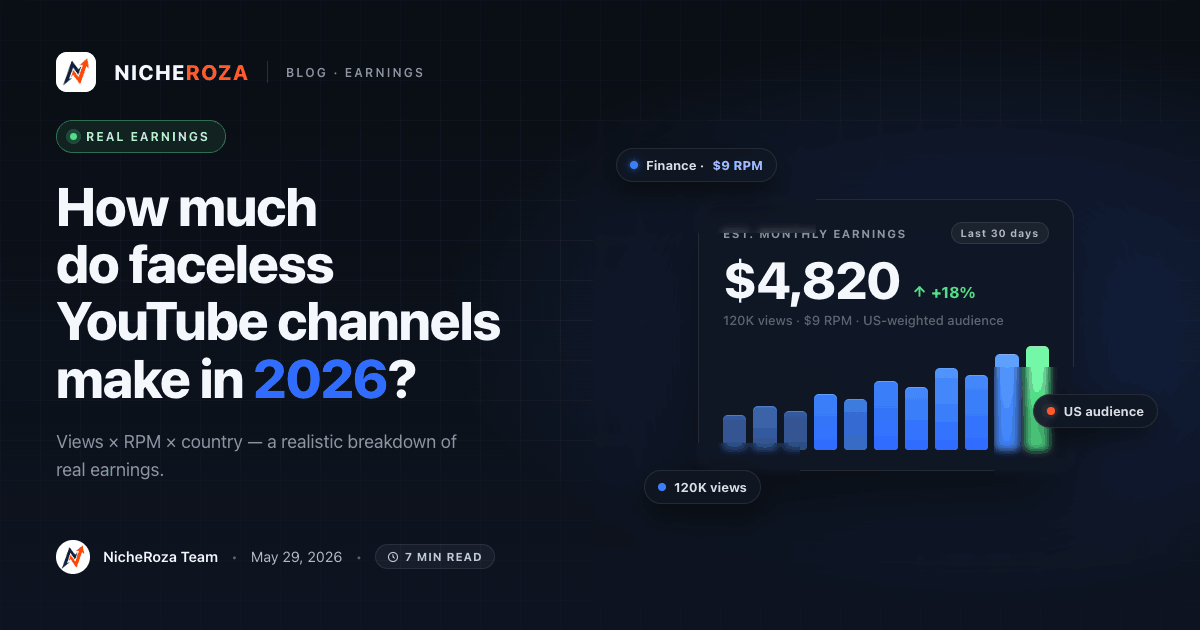
Short answer: Faceless YouTube income isn't a single number — it's your monthly views multiplied by your RPM (what you actually take home per 1,000 views after YouTube's cut). As the post's own example shows, a channel with a $4 RPM and 500,000 monthly views earns roughly $2,000 from ads that month. Because both views and RPM swing dramatically with niche and audience country, a flat "per 1,000 views" figure is almost useless on its own.
"How much do faceless YouTube channels make?" is one of the most searched questions in the entire creator economy — and it's also the one with the most misleading answers. You'll see screenshots of $10,000 months sitting right next to creators admitting they made $40 after a year. Both can be true, because faceless YouTube income isn't a single number. It's the result of three things multiplied together: how many views you get, how much your niche pays per view, and where your audience watches from.
This guide breaks down what faceless channels realistically earn in 2026, the math behind those numbers, why two identical-looking channels can earn wildly different amounts, and how to estimate your own income before you ever upload a video.
The Simple Formula Behind YouTube Income
Almost all AdSense income on YouTube comes down to one equation: your views multiplied by your RPM. RPM is what you actually take home per thousand views, after YouTube's cut and after unmonetized views are factored in. So a channel earning a $4 RPM with 500,000 monthly views makes roughly $2,000 from ads that month.
The reason income estimates vary so wildly is that both numbers swing dramatically. Views depend on your niche, consistency, and how well the algorithm picks up your content. RPM depends on your topic and your audience's country. Change either input and the result moves by multiples — which is exactly why a flat "per 1,000 views" figure is almost useless on its own.
What Faceless Channels Realistically Earn
It helps to think in stages rather than promises. A brand-new channel that hasn't crossed the monetization threshold earns nothing from ads yet, no matter how good the videos are — this stage is normal and most channels spend their first months here.
Once monetized, a small faceless channel doing tens of thousands of views a month typically earns modest pocket money — enough to cover tools, not rent. A mid-sized channel pulling a few hundred thousand monthly views in a decent-RPM niche can reach a meaningful side-income level. The channels posting the eye-catching screenshots are usually doing millions of monthly views in a high-RPM niche with a high-paying audience — a combination that's achievable but far from typical. The honest framing for 2026: faceless YouTube can absolutely pay, but the realistic path runs through months of consistency before the numbers get interesting.
Why Niche Changes Everything
Two channels with the exact same view count can earn several times apart purely because of niche. Advertisers in finance, business, and technology pay far more to reach viewers than advertisers in entertainment or general vlog-style content, so the RPM gap is enormous.
This is why a smaller finance or tech channel can out-earn a much larger entertainment channel. If you're choosing what to make, the earning ceiling of the niche matters as much as how easy it is to produce. Our guide to the best faceless YouTube niches in 2026 breaks down which niches combine real demand with a strong RPM, so you're not optimizing views in a niche that barely pays.
Why Audience Country Matters Just as Much
The second multiplier is geography. A view from a high-paying advertising market can be worth many times more than a view from a low-RPM region, even for identical content. That means a channel with mostly US, UK, Canadian, or Australian viewers can earn far more than a channel with the same views from lower-RPM markets.
This isn't something you fully control, but you influence it through your topic and language. Content that naturally attracts higher-paying audiences shifts your economics before you upload a single video. We cover the full picture of how earnings move across regions in our deep dive on YouTube RPM by country.
Income Beyond AdSense
Ads are only the floor. Many faceless creators earn more from everything around the ads than from the ads themselves. Affiliate links work especially well in review, tech, and tool-focused niches where viewers have buying intent. Sponsorships become available once you have a consistent audience, and they're often paid as a flat fee regardless of RPM. Digital products, memberships, and even selling the channel itself are all real income streams.
The practical takeaway is that AdSense RPM sets your baseline, but your total income depends on how many of these layers you stack on top. A channel with a modest RPM but strong affiliate fit can out-earn a higher-RPM channel that only runs ads.
How to Estimate Your Own Earnings
Generic averages blend every niche and country into one meaningless figure, so they're a poor planning tool. To estimate realistically you need three specific inputs: your niche, your audience's main country, and a realistic view target based on how often you can publish.
The faster way is to model it directly instead of guessing from other creators' screenshots. NicheRoza's RPM predictor estimates monthly AdSense income across 14 categories and 20 countries, so you can plug in your actual niche and target region rather than a global average — and it's part of the free plan. From there the workflow is simple: confirm small channels are breaking through in the niche, check the RPM for your country, then commit. If you're at the very beginning, our step-by-step guide to starting a faceless YouTube channel puts these steps in order.
Conclusion
So, how much do faceless YouTube channels make in 2026? Anywhere from nothing to a full-time income — and the difference comes down to views, niche RPM, and audience country, multiplied together and then extended by affiliates and sponsorships. The creators who earn the most aren't chasing a magic per-view number; they picked a high-RPM niche, attracted a higher-paying audience, and stayed consistent long enough for the algorithm to reward them. Estimate your own numbers for your real niche and region before you build a plan around them, and treat any single "average" figure with healthy skepticism.
FAQs
How much do faceless YouTube channels make per 1,000 views? It depends entirely on niche and audience country. The same 1,000 views can be worth a few times more in a high-RPM niche like finance with a US-based audience than in a low-RPM entertainment niche.
How many views do you need to make money on YouTube? You first need to meet YouTube's monetization requirements. After that, meaningful income usually requires consistent monthly views in the hundreds of thousands, though high-RPM niches need fewer views to earn the same amount.
Can a faceless channel become full-time income? Yes, but it typically takes months of consistent publishing plus a niche with a strong RPM and multiple income streams beyond ads, such as affiliates and sponsorships.
What's the fastest way to estimate my earnings? Use a tool that factors in both your niche and your audience country rather than a single global average. NicheRoza's RPM predictor estimates monthly income across 14 categories and 20 countries on its free plan.
Start faceless niche research. Free.
Outlier detection, AI Score, channel tracking — in one panel. No card required.
Start free →